September 22, 2026
Small States Agency in South Asia: India-Maldives Relations
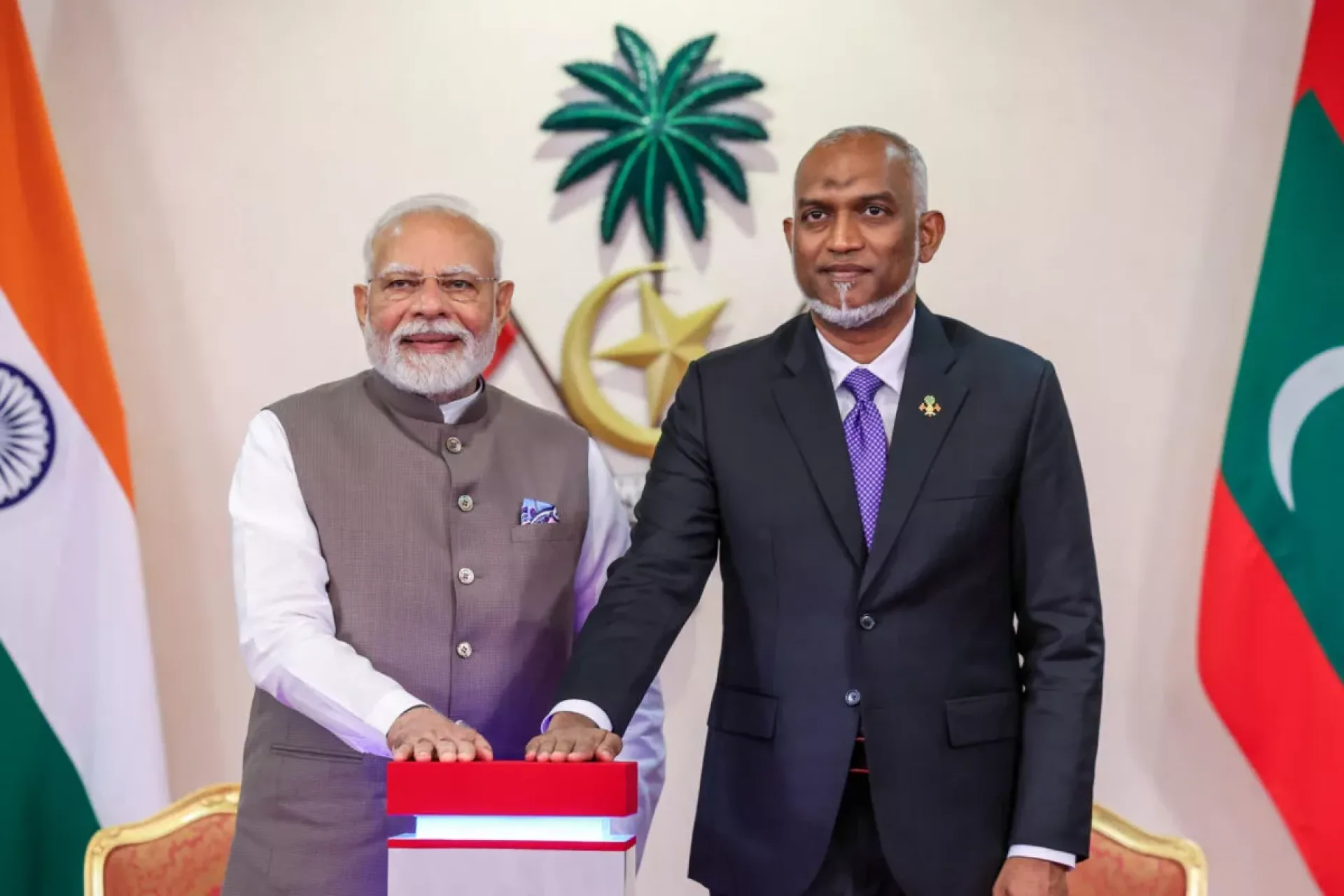
Fig 1. Indian Prime Minister Narendra Modi with Maldivian President Mohamed Muizzu during 2023 visit (Photo: File, East Asia Forum)
The enduring bilateral relations between Maldives and India are insightful chapters in the history of the South Asian region. After a period of intense nationalist rhetoric and tension during the 2023 Maldivian presidential election campaign season, bilateral ties between Maldives and India have been on a gradual path to diplomatic restoration. This momentum is spearheaded by President Dr. Mohamed Muizzu and his administration working in concert with India’s long-serving Prime Minister Narendra Modi.
Recent highlights of their bilateralism include notable state visits, mutual celebrations for 60 years of diplomatic ties, trade expansions, project completions and further negotiations of prospective commitments. Heading into the final months of 2026 and beyond, analyzing the recent developments of this relation would be critical in understanding where it stands and what to expect in the future as President Dr. Mohamed Muizzu today walked side by side with the High Commissioner of India to the Maldives G. Balasubramanian on the Malé-Thilafushi Bridge, known as the Greater Malé Connectivity Project supported by the Government of India.
The is a historic development project beyond only its scale and even in the terms of this project which includes a 20 year repayment period at 1.75% interest. According to public information, the project is valued at $500 million, $100 million is a grant, while $400 million is on Line of Credit by the EXIM Bank of India.
Road to Reconciliation
While the sudden shift in attitude towards India from the viral “India Out” campaign to Prime Minister Modi being invited to the Maldives as the guest of honour for the 60th anniversary of India-Maldives relations may be a puzzling series to some, the truth lies in careful political pragmatism. Many experts and political analysts widely agree that the “India Out” campaign served as a calculated and effective strategy by the People’s National Congress (PNC) to appeal to the nationalism, patriotism and sovereignty concerns of Maldivian voters during the 2023 presidential election. The campaign aimed at exposing and magnifying alleged Indian military personnel on Maldivian soil that were supposedly a risk for potential national security; while simultaneously portraying PNC’s opposition to the incumbent Maldivian Democratic Party as overly accommodating to New Delhi at the cost of sovereignty. This domestic political gambit effectively mirrored and later progressed into the realist foreign policy doctrine of “Maldives First” on the international stage.
The doctrine of “Maldives First” introduced by President Dr. Muizzu is a key foreign policy tool that offers additional insights on the India-Maldives relations and Maldives’ broader goals internationally. As per the official statements by Maldives’ ministry of foreign affairs, the Maldives First doctrine is a reaffirmation of the commitments to safeguarding national sovereignty, pursuing national interests, promotion and protection of human rights, upholding national and international law, and constructive engagement with all bilateral and multilateral partners through established diplomatic protocol and engaging as equals.
Thus, Maldives’ expeditious reconciliation efforts with India are evident by President Dr. Muizzu’s October 2024 visit to India where India and Maldives bilaterally adopted the “Vision for Comprehensive Economic and Maritime Security Partnership” agreement, the aforementioned guest of honour visit by Prime Minister Modi in July 2025, and Foreign Minister Iruthisham Adam’s official visit to India in May 2026. The Maldives and India have been fast friends more often than not, both historically and culturally.
Cooperation and Commerce
Recent achievements in the domain of bilateral cooperation and commerce are also grounded in political pragmatism as much as they are in mutual friendship. Far from letting election-era rhetoric permanently fracture ties, both governments have leveraged structural economic alignments to drive regional enrichment and stability. Some notable highlights are:
The joint military exercises in preparation for counter-terrorism and counter-insurgency are evident by the “EKUVERIN” operations. The Greater Malé Connectivity Project which remains a top-priority project for both governments. Negotiations for an India-Maldives Free Trade Agreement expected to finalize by the end of 2026. Multiple memorandums of understanding and amendatory agreements reducing Maldives annual debt repayment by about 40%.
Business outlets also report that bilateral trade between India and Maldives rose by 13.5% (USD 771.76 million) in 2025-2026 August. While one might expect such growth to stem primarily from higher Indian exports to the import-dependent Maldivian economy, available figures reveal a different reality. A significant portion of that 13.5 percentage increase was due to Maldivian exports to India, with inflationary global price effects likely playing a secondary role. Although the absolute scale of this export growth remains modest, this development does suggest that, if sustained and broadened beyond a narrow range of commodities, Maldives possesses the potential capacity to gradually expand its production and export base. In this sense, continued efforts at domestic market development and diversification could positively reinforce the economic pragmatism underpinning the Maldives First doctrine.
Efforts in International Organizations
Beyond bilateral diplomacy, India-Maldives relations are also strengthened through regional security forums and multilateral organizations. A key platform in this regard is the Colombo Security Conclave (CSC), where the Maldives works alongside India, Sri Lanka, Mauritius, Bangladesh, and Seychelles to address shared security concerns in the Indian Ocean Region. Maldives’ participation in high-level meetings, including the 7th summit in late 2025, reflects its growing role in tackling non-traditional security challenges. Moreover, cooperation under the CSC covers areas such as maritime domain awareness, including efforts through the Information Fusion Centre–Indian Ocean Region (IFC-IOR) to address issues like illegal fishing and piracy, as well as maritime exercises and Humanitarian Assistance and Disaster Relief (HADR) operations. The two countries notably also cooperate on cybersecurity, counterterrorism, and the protection of critical infrastructure. Thus, by sustaining efforts through wider regional frameworks such as the CSC, the Maldives can strengthen its security partnerships while maintaining its independence and avoiding an overreliance on any single foreign power. This approach further supports the Maldives First doctrine and the current administration’s broader emphasis on preserving its strategic autonomy while contributing to regional security.
The China Counterbalance
While India remains an indispensable ally to the Maldives in terms of primary security collaborator and geographic neighbour, Maldives continues to engage in comprehensive dialogue with many other states, most prominently China. President Dr. Muizzu’s efforts in high-level diplomacy with China have yielded numerous advances for the Maldives. This includes a free trade agreement between China-Maldives that came into effect in 2025 (conspicuously a year earlier than The Maldives’ potential free trade agreement with India). Likewise, the Maldives-China Comprehensive Strategic Cooperative Partnership is also a noteworthy bilateral agreement between the two nations that included several memorandums of understanding, key grants and action plans. Official visits to local islands by the Chinese Ambassador in 2026 also served as an extension to China’s facilitative assistance to Maldives in areas of tourism, health technology and agriculture. Rather than an explicit geopolitical realignment away from New Delhi, these initiatives illustrate realist small-state behaviour of diversifying economic partnerships with other states to prevent single-source dependency on India, giving the Maldives maximum leverage to pursue its "Maldives First" foreign policy goals on the international stage moving forward.
Small States Actions as Strategic Hedging and Agency.
While the nature of modern day Maldives foreign policy characterised by strategic hedging that leverages the development needs of the small state is evident in the shifts with successive administrations. The ultimate reality is that India is and will continue to be geographically and historically a key friend to the Maldives, a helper of first resort in every crisis past and likely in the future.
About the Author
Mohamed Hoodh Ibrahim is the Chairperson of the Maldives Centre for Policy Research, and Political Scientist and Researcher at The Maldives National University. He has published research for UNESCO, UNDP, ADB and CCPR.
Hoodh also serves as the elected UNESCO IYF Regional Facilitator for Asia Pacific, and the Vice President of the Maldivian Red Crescent Governing Board.