Policy Proposal for the Maldives Organic Food Security Agricultural Program (MOFSAP)
February 18, 2025
INTRODUCTION
Maldives Organic Food Security Agricultural Program (MOFSAP) is a food security policy pilot and intervention program designed to increase food security of the Maldives using free market demand for organics in the tourism sector to scale up domestic agriculture production in selected crops.
The key goal of MOFSAP is to develop the farmers value chain through market-driven commercialization and diversification with a sustainable level of protection.
MOFSAP is designed in alignment with the Government of Maldives strategy to develop the agriculture sector including strengthening agricultural value chains and productive capacity of farmers, increasing the role of agriculture in achieving food safety and food security, mainstreaming sustainable agricultural practices, and strengthening research in alternative agricultural technologies.
BACKGROUND
Maldives has a high dependency on imports for commercial and consumer needs.
Reliance on imports which exceeded US$118 million of fruit and vegetables prior to the pandemic in 2019 of which an estimated 65% of vegetable imports and 35% of fruit imports are for consumption by the resident (non-tourist) population (IFAD, 2021).
Nutrition levels are concerning as Global Nutrition Report noted in 2023, child nutrition status improved over the last decade, progress is slow with small improvements in stunting, wasting and underweight among children under 5 years. For stunting, the latest prevalence data shows that 19.0% of children under 5 years of age are affected. This is lower than the average for the Asia region (21.8%). For wasting, the latest data shows that 10.6% of children under 5 years of age are affected. This is higher than the average for the Asia region (9.1%), (IFAD, 2021).
Markets in many Small Island Developing States (SIDS) are constrained in their activity by the key determinants of the states’ smallness and isolation (Driessche, 2023). This often results in high unit costs for goods as cargoes are small, mixed and subject to expensive freight costs (Briguglio 1995) (Driessche, 2023). Becker (2012, 1) added that the ‘tyranny of distance’ in Pacific SIDS inflated production costs thus hindering access to markets for producers. Diseconomies of scale and inefficiencies in production contributed to many SIDS becoming net importers of food (Poonyth and Ford 2005) resulting in food security being more predicated on purchasing power for food imports rather than local production capacity. Acknowledging the Maldives’ continuing status as a net food importer, IFAD (2020, 3) noted: ‘that about 95% of the country’s food consumption is met by imports’. This has led to periodic food insecurity in the outer islands where infrequent and expensive food distribution can result in food shortages (IFAD 2020). In addressing Maldivian food import dependency, successive National Development Plans and accompanying programmatic interventions, have sought to rectify capacity deficits in agricultural supply chains that lead to low agricultural output. This was most recently iterated in the Strategic Action Plan 2019–2023 where capacity deficits in areas such as technical expertise and transportation connectivity were noted (GoM 2019) (Driessche, 2023).
PARTNERS
MOFSAP is designed and implemented by Maldives Organics Movement (MOMO) and Centre for Policy Research (MCPR) in association with the Maldives National University, Owita Naturals Pvt Ltd, and ABBA Agri Consultancy in Sri Lanka and JADAM Organic Farm and Garden Technology in South Korea.
Associates and partners of MOFSAP will support in areas of on-site expert technical consultancy, knowledge and technology support.
MAFSOP is inspired by the values of the Food and Agriculture Organization of the United Nations and the International Federation for Organic Agriculture Movement (IFOAM).
MOFSAP will research and innovate organic food production in Maldives by implementing emerging natural and organic technologies from Sri Lanka and South Korea to build scale in production, resilience for farmers and develop Maldives organic farming sector to meet local consumption. JADAM generously shares technical resources and expertise on providing pest control and disease prevention and nutritional needs of crops
RESILIENCE FARMING MODEL
Farmers enrolled and practicing farming under MOFSAP principles, will be structured into a cooperative society, thereby giving selling and leveraging powers. MOFSAP will offer farmers security through fixed term standard price contracts including a safety net of 10% variation for upper and lower limit in relation to market price variation. These protections are planned to incentivise farmers to invest their time and effort to build up the organic farming sector.
MOFSAP combines the MOFSAP Roadmap 6 pillars to build resilience into the food security of the Maldives by transforming existing farms to organic production, cultivating the market need through market and product development, and scaling production by leasing land for organic farming and processing facilities in GDh. Vaadhoo.
Leasing and developing an organic agriculture island (Leasing an island for Agricultural purpose: development of organic agricultural island)- Proposal ?
CROPS AND TARGETS
MOFSAP targets to meet 5% of national production in the agriculture sector in 10 years. The program will target special selected food security crops meant to ensure food security for the Maldives.
Crops have been selected and proposed based on natural capacity to grow in tropical climate of Maldives and existing domestic and tourism market demand,
Breadfruit
Sweet Potato
Taro
Banana
Watermelon
ROADMAP FOR MALDIVES ORGANIC FOOD SECURITY AGRICULTURAL PROGRAM
Approach
Organic agri production — Scoping and developing farmer/producer network
Marketing and trade platform — Retail and e-commerce platform
Organic verification and developing trust among consumers
Consumer awareness and promotion — consumer network
Pricing mechanism with protections
Coordinating and facilitating system
Organic agri production — Developing farmer/producer network
Identify potential individual farmers, farmer groups and organizations (schools, community groups, resorts, volunteer organizations).
Farmer trainings on basic organic farming practices
Crop establishment
Input production and soil development
Crop management practices
Harvesting and postharvest practices
Marketing and trade platform — Retail and e commerce platform
Identify a retailer/ setting up farmer’s market or pop up market
Design a logo/ brand name/ tagline etc
Setting up website and social media platforms
Approach media
Organic verification and developing trust among consumers
Setting up the Maldives Participatory Guarantee Systems (MPGS), a locally focused quality assurance system. PGS certify producers based on active participation of stakeholders and are built on a foundation of trust, social networks and knowledge exchange. MPGS network introduction will include;
PGS documentation
Creating PGS logo
Farmer training
Training technical members/ traders/ lead consumers
Social media
Consumer awareness and promotion — consumer network
Create consumer awareness on organic consumption
Healthy and natural food consumption promotion
Promoting home gardening
Developing organic consumer network
Pricing mechanism
Analyze conventional pricing structure at fruits and vegetables in the market
Identify fast moving products
Calculating cost of production for various crops
Setting up organic pricing mechanism to promote organic affordable for majority
Coordinating and facilitating system
Appoint a local coordinator to coordinate and facilitate the system discussing with different stakeholders
Continue the PGS certification system/field visits
MARKET ANALYSIS
Source: National Fisheries and Agricultural Policy 2019–2029
Explain how the data is relevant or linked to the project,
Maldives has commercial agriculture however it is unclear whether the current model is supporting food security (IFAD 2020) (Van Driessche, 2018).
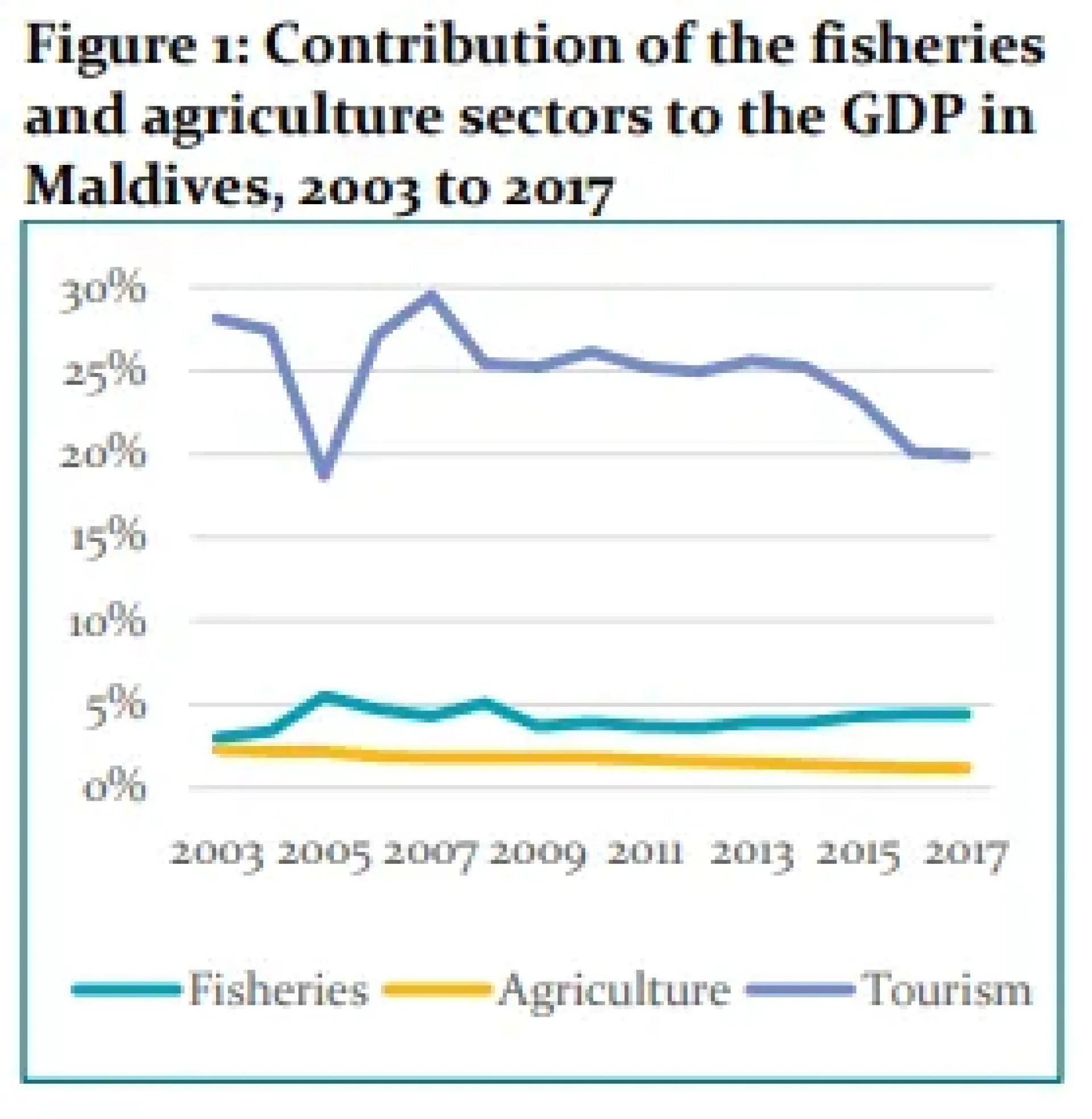
The Maldivian National Bureau of Statistics noted that the agricultural sectors’ contribution to Gross Domestic Product declined from a high of 7% in 1984 to 1.6% in 2020 (National Bureau of Statistics 2021). Is there any reason for the decline in number? GDP shift to tourism in the Maldives and the agriculture sector thrive with the increase of domestic food production and supply to resort, hotels, guesthouses: explain how this project can make the connection. Can this be reversed by increasing investment in this sector? Importance of integrated farming approach.
The number of registered farmers in the Maldives has also fallen from a 2013 high of 9,973 to 7,611 in 2019 (National Bureau of Statistics 2020). Is there any reason for the decline in number? Lack of availability or land/island for agricultural purpose? Or yield low? Use of pesticides negatively effect? Not profitable for local farmers? Farmers cannot identify the target market for their product. Does farmer need assistance? Can this project help to increase farmers number or create more awareness? To establish a standard? Can gov incentives help farmers? A longterm sustainable approach is required to maintain agricultural sector.
Please see below current production of agriculture sector:
[Fig Source: Maldives Customs Services (2022)]
Production has been on a declining trend for the past 5 years.
[Fig Source: Maldives Customs Services (2022)]
INVESTMENT COST AND RETURN
2025 ANNUAL WORK PLAN AND BUDGETING (AWPB)
First 14 weeks pledge: Under Economic and Environmental goals set forth by the government include;
04.24 : Introduction of a special policy to reduce the prices of basic food items.
04:25: Increase the allocation to the agricultural sector in the state budget.
04:26: ަinitiate a ‘pilot project’ check if ‘vertical farming’ can be widely practiced in the country.
Maldives is vulnerable to the impact of climate change which may affect food security, food safety and nutritions. So sustainable agriculture or environment-friendly agricultural methods are important to explore. (shift towards more sustainable agricultural practices). Eg: Agroforestry technique to reduce soil erosion, etc https://regenx.ag/blog/sustainable-agriculture-examples/
First it is important to recognize and address challengers in conventional farming.
Over the years,there is a trend where more islands in the Maldives are leased for tourism development purposes. More focus is on tourism development than ensuring food security.
Farm island tour experience:tourist from guesthouses tour to the farm island.
Agriculture value chains?
Among the 17 Global Goals or SDGs, Goal 2 addresses global food security and agricultural sustainability requiring urgent and concerted action from developed and developing countries.
Testing the viability of hydroponics.
Links:
https://www.unescap.org/sites/default/files/South%20Asia%20Policy%20Dialogue%20on%20Regional%20Cooperation%20for%20Food%20Security%20-%20Dr.%20Abdulla%20Naseer.pdf
https://www.presidencymaldives.gov.mv/Press/Article/30314
https://presidency.gov.mv/Press/Article/29644
https://mfr.mv/public-sector/maldives-parliament-passes-food-safety-bill
https://www.maldiveseconomicreview.com/post/delivering-food-security-in-the-maldives-agricultural-sector
https://corporatemaldives.com/report-an-island-nations-hunger-can-the-maldives-cultivate-food-security-in-a-sea-of-challenges/#:~:text=With%20over%2090%25%20of%20its,import%20flows%2C%20triggering%20food%20shortages.
https://pickyourtrail.com/blog/farm-islands-in-maldives/
https://investmaldives.gov.mv/Opportunities/Agri
https://www.gazette.gov.mv/iulaan/288416
References
International Fund for Agricultural Development. (2021, October). Maldives country strategy note 2022–2023. IFAD. https://www.ifad.org/en/-/maldives-country-strategy-note
Van Driessche, P. A. (2023). Agricultural Producer Markets in the Maldives: How Poor Market Connectivity Between Farmers and the Markets can be Enhanced. International Journal of Rural Management, 20(1), 24–44. https://doi.org/10.1177/09730052231161897